
July 9, 2026
Points & MilesIs a Flying Blue Promo Fare Actually Worth It? I Ran the Math on Three Real Redemptions

Every month, Flying Blue, the loyalty program shared by Air France and KLM, releases a fresh batch of Promo Rewards, discounted award tickets that refresh on the first of each month. Right now there is a strong one: 25 percent off Economy awards to Europe from Toronto, Montreal, and Ottawa, with the Ottawa deal reserved for Flying Blue Extra members. An Economy reward to Europe that would normally start around 25,000 miles one way drops to roughly 18,750 miles one way at a 25 percent discount, which means 37,500 miles plus taxes and fees round trip. That sounds great, right?
But here is the part that is very important when you are looking at a points redemption. A promo fare is only a deal if it beats paying cash. The miles required might be low, but Air France and KLM are known for loading taxes and carrier-imposed surcharges onto award tickets. Once those fees are factored in, some promo redemptions barely break even, and a few are worse than simply buying the ticket outright.

The catch is that award value is easiest to find in premium cabins, where inflated cash prices give your miles a large gap to absorb. Economy fares sit much closer to the ground, so there is less room for miles to do real work, which is why you have to compare points against cash before every booking.
To show what that looks like, I pulled three real economy round trips out of Montreal, all on the same promo at an identical 37,500 miles round trip, and measured each with cents per point, or CPP: the cash price, minus the award's taxes and fees, divided by the miles, times 100. My rule of thumb with Flying Blue is to aim for around 2 cents per mile. Hit that and the miles are working for you; fall short and you are usually better off paying cash.
Note: To calculate cents per point (CPP), take the cash price, minus the award's taxes and fees, divided by the miles, times 100.
Let's dive into it!
Paris (YUL–CDG, nonstop both ways)
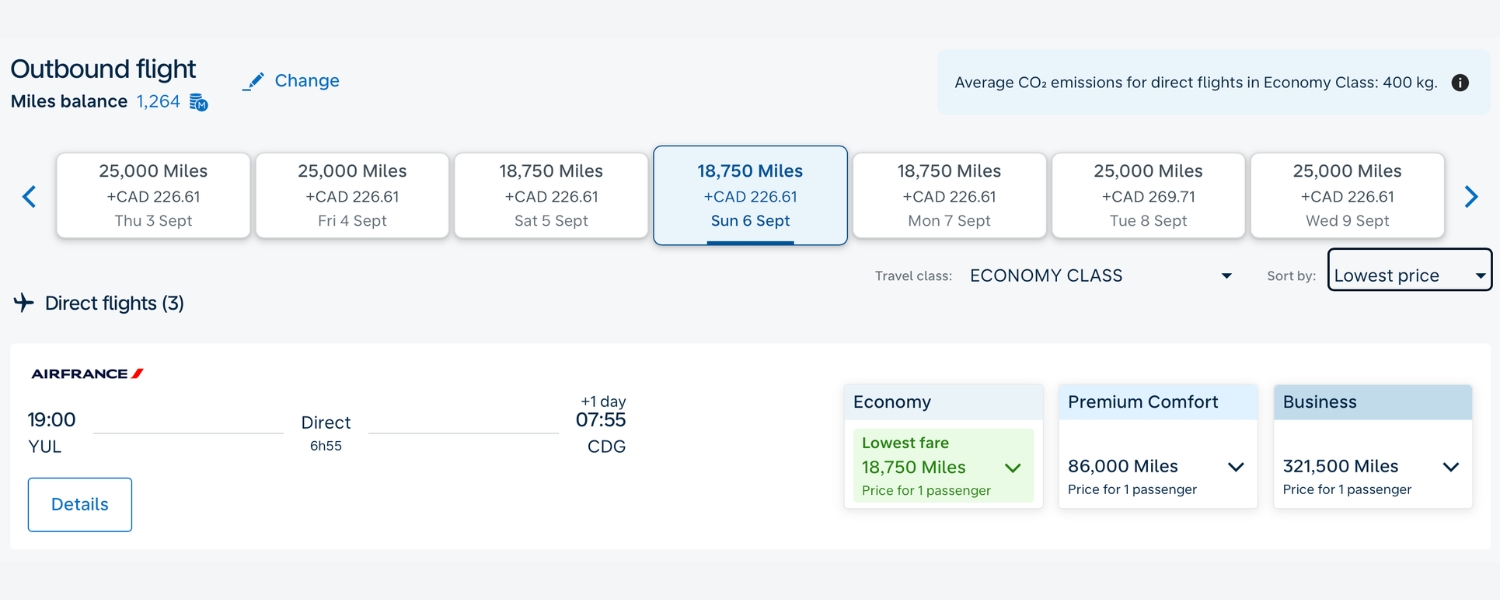
Flying Blue award, outbound YUL to CDG nonstop, 18,750 miles plus $226.61 CAD. Source: Flying Blue.
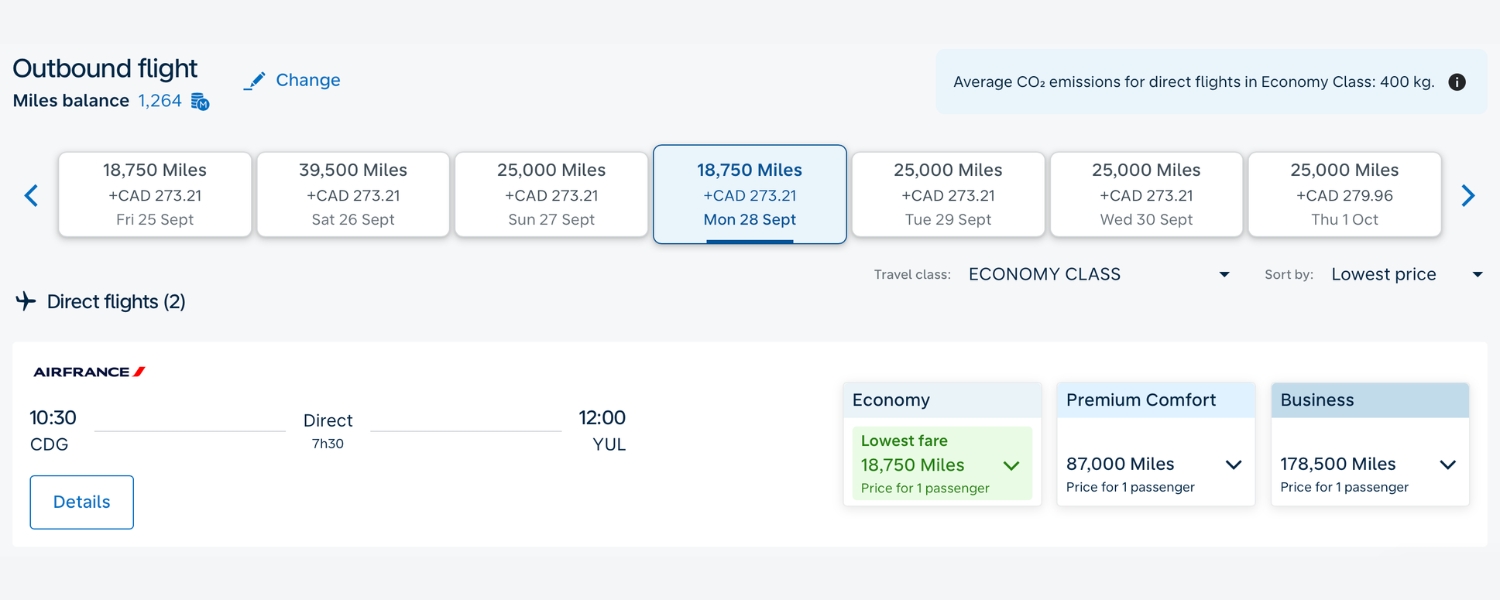
Flying Blue award, return CDG to YUL nonstop, 18,750 miles plus $273.21 CAD. Source: Flying Blue.
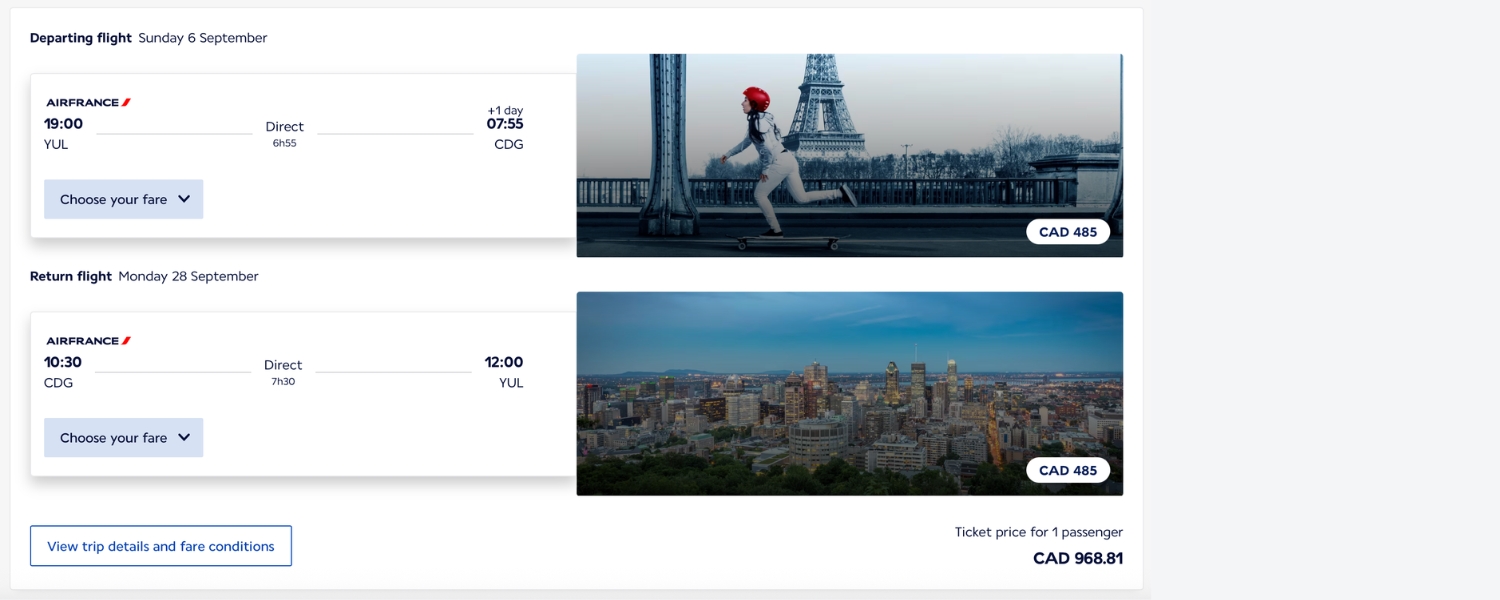
Cash fare, YUL to CDG round trip nonstop, $968.81 CAD. Source: Air France/KLM.
The math: ($968.81 − $499.82) ÷ 37,500 × 100 = 1.25 cents per mile
Paris is one of the most competitive routes out of Montreal. Several carriers fly it, many of them nonstop, and that constant competition keeps cash fares low. Here the whole nonstop round trip on Air France comes to $968.81 CAD, which is relatively competitive for a transatlantic economy standard fare ticket.
That is exactly why the redemption falls flat. With $499.82 CAD in taxes and surcharges baked into the award, more than half the cash price is being charged on top of the miles anyway, and the cash fare itself is too low to leave your miles much to absorb. At 1.25 cents per mile, this sits well below our 2 cent target. On a route like Paris, the smart move is to pay cash and keep your miles for somewhere they go further.
Athens (YUL–ATH, connecting)
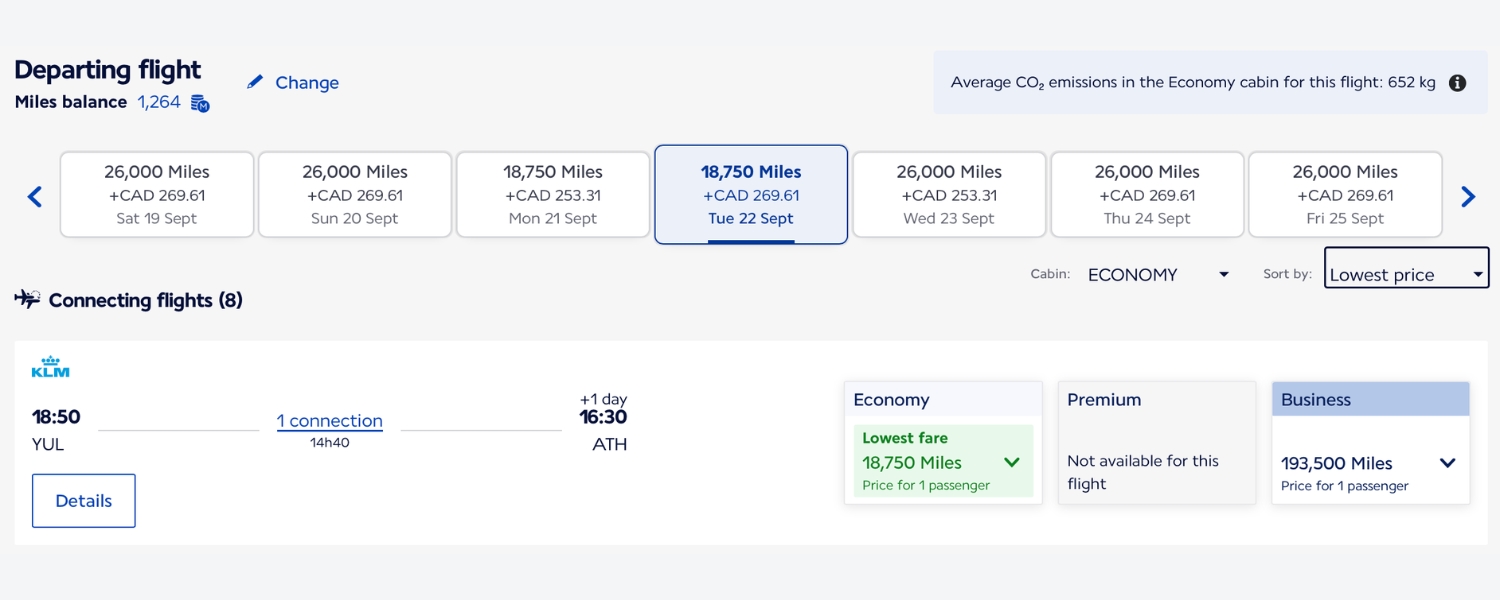
Flying Blue award, outbound YUL to ATH, 18,750 miles plus $269.61 CAD. Source: Flying Blue.
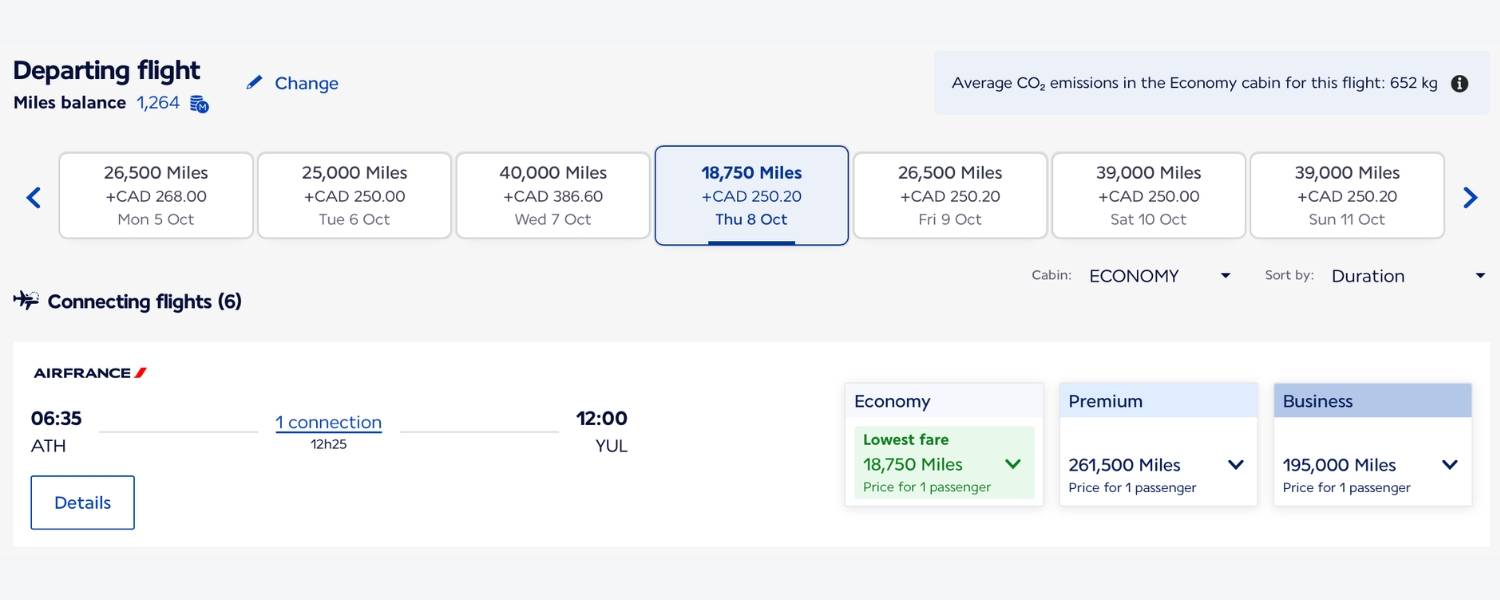
Flying Blue award, return ATH to YUL, 18,750 miles plus $250.20 CAD. Source: Flying Blue.
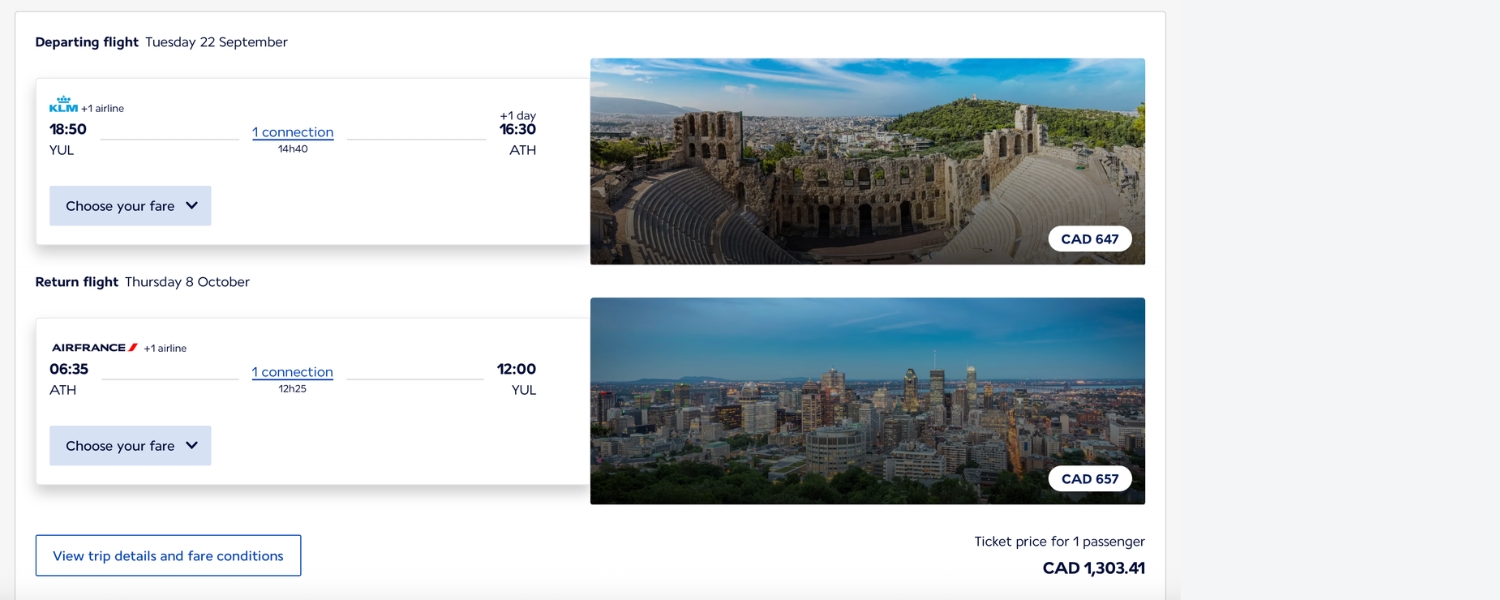
Cash fare, YUL to ATH round trip, $1,303.41 CAD. Source: Air France/KLM.
The math: ($1,303.41 − $519.81) ÷ 37,500 × 100 = 2.09 cents per mile
Athens is a different market. A couple of carriers do fly Montreal to Athens nonstop, but only seasonally, and competition overall is far lighter than on a route like Paris. That keeps cash fares elevated, and it shows here at $1,303.41 CAD for a connecting round trip. The surcharges are almost identical to the Paris award, but the cash comparable is several hundred dollars higher, and that gap is what your miles get to absorb.
The result lands right on target at 2.09 cents per mile. This is the kind of redemption where using miles starts to make real sense: a route expensive enough in cash that the points are pulling their weight, without being so pricey that you would never consider paying out of pocket.
Belgrade (YUL–BEG, connecting)
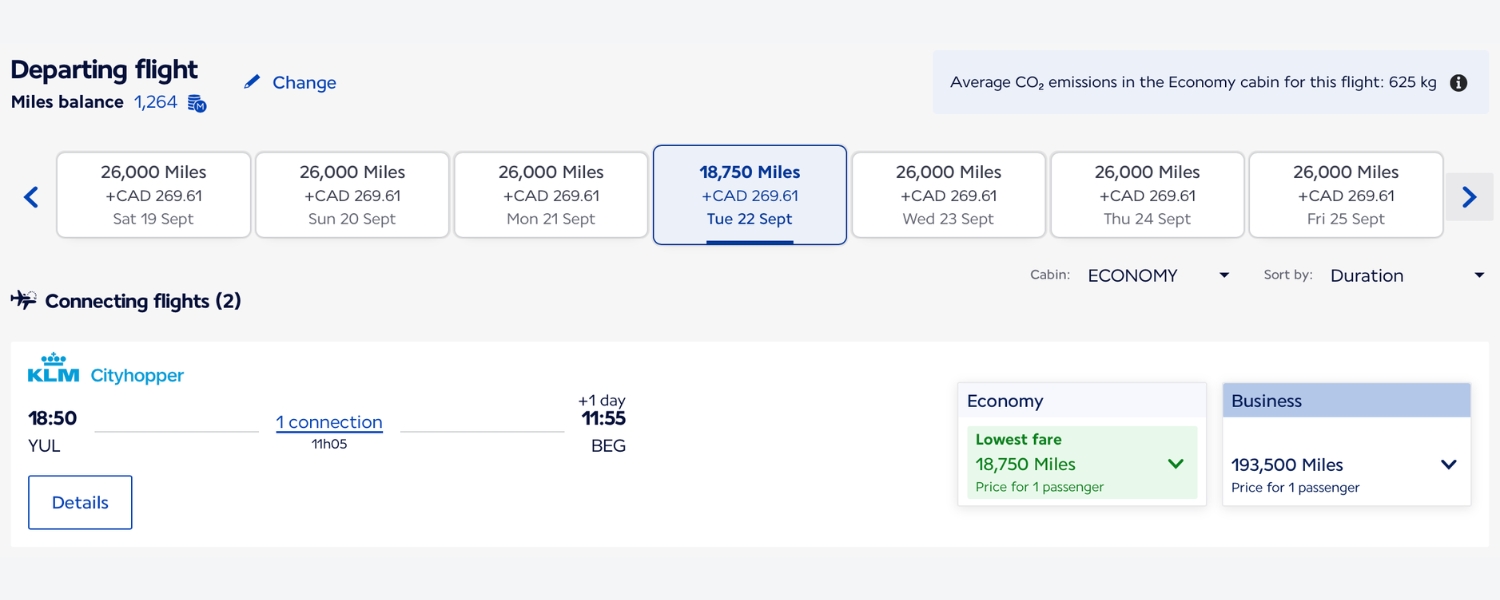
Flying Blue award, outbound YUL to BEG, 18,750 miles plus $269.61 CAD. Source: Flying Blue.
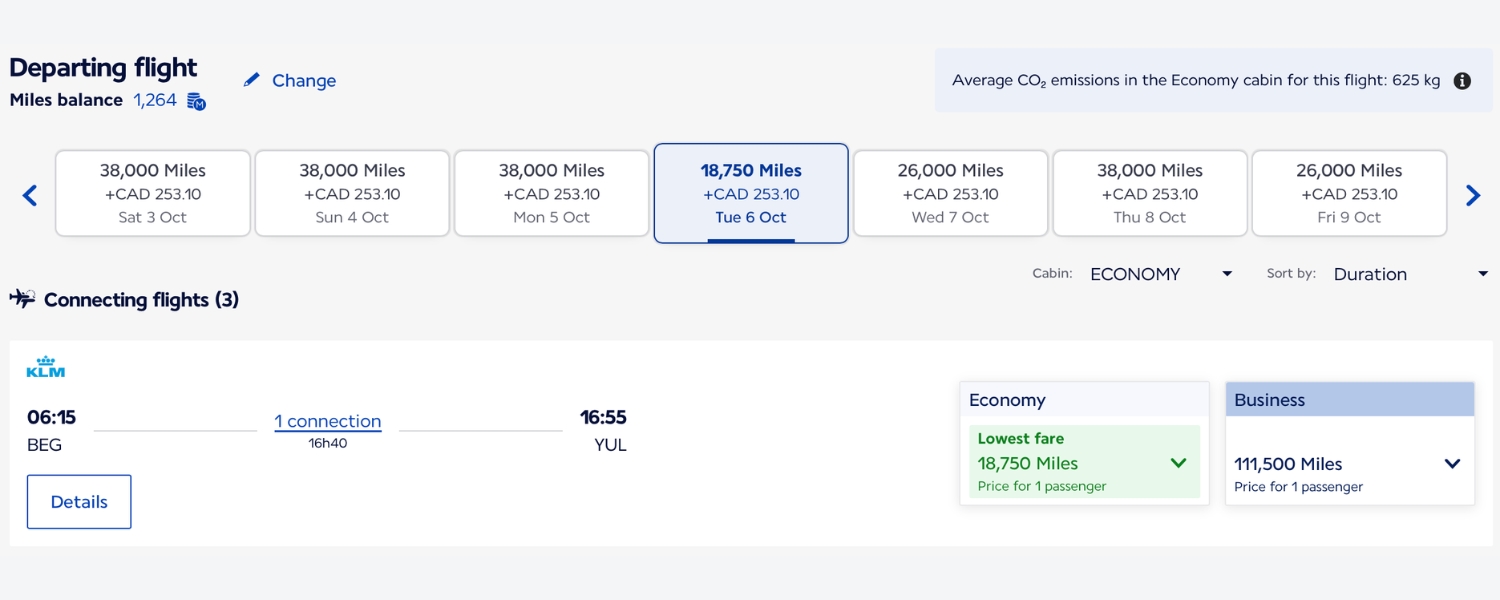
Flying Blue award, return BEG to YUL, 18,750 miles plus $253.10 CAD. Source: Flying Blue.
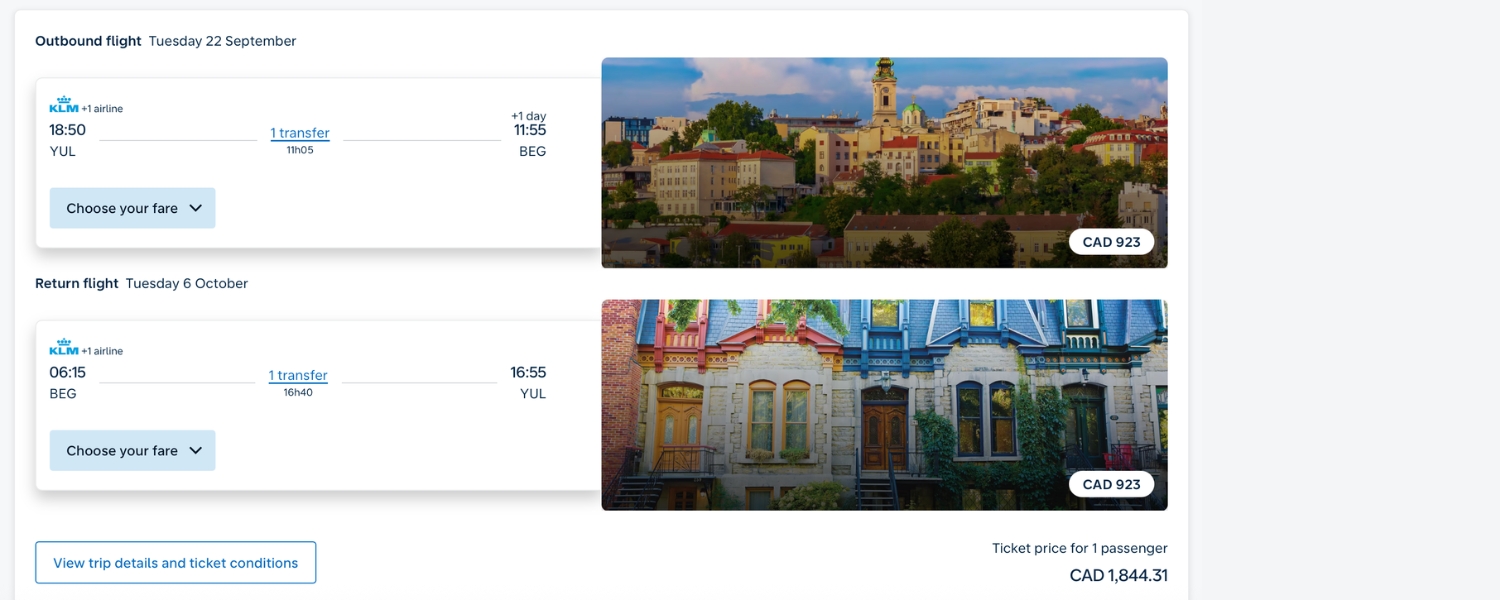
Cash fare, YUL to BEG round trip, $1,844.31 CAD. Source: Air France/KLM.
The math: ($1,844.31 − $522.71) ÷ 37,500 × 100 = 3.52 cents per mile
Belgrade takes the Athens logic and pushes it further. It is a thin, low-competition market from Montreal and Canada in general. The only nonstop from Canada runs seasonally out of Toronto through September 2026, and there is nothing nonstop from Montreal, so cash fares run high, here reaching $1,844.31 CAD for a connecting economy round trip. The award taxes are in the same range as the other two, so almost that entire cash price is value your miles are absorbing.
At 3.52 cents per mile, this is well above target and nearly triple the Paris result on the exact same promo. Routes like this, where cash fares run high because so few airlines serve them, are precisely where you want to spend Flying Blue miles.
How to Spot the Good Ones

The pattern across these three comes down to one thing: competition. The promo mileage cost is identical no matter where you fly, so your CPP rides almost entirely on the cash price, and the cash price is set by how many airlines fight over the route.
Favor routes with little competition. Heavily served routes like Montreal to Paris keep cash fares low, which is why the miles fell short there. Thinner markets like Athens, and especially Belgrade, carry pricier cash fares, so the same miles stretch far further.
Book high season and busy travel windows. Timing works the same way as competition. When cash fares spike over holidays, summer peaks, and popular event weeks, your miles absorb more of an inflated price and your CPP climbs.
Watch the surcharges. Air France and KLM load heavy carrier-imposed fees on economy awards, often more than $500 CAD round trip even on a promo. If you hold a transferable currency, it is worth checking whether a partner program with lower surcharges prices the same route more cheaply before you commit.
Aim for two cents, and do the math every time. A 25 percent discount on miles means nothing on its own. Run the numbers before you book: cash price, minus taxes and fees, divided by miles, times 100. If it clears roughly 2 cents per mile, book it. If it does not, pay cash and save the miles.
The Bottom Line

Flying Blue's monthly promos are one of the better recurring deals in the points world, but the discount on the sticker is not the same as value in your pocket. As these three Montreal round trips show, the exact same promo, at the exact same mileage cost, ran from a skip-it 1.25 cents to a standout 3.52 cents, purely because of how much each route costs in cash.
The lesson is simple. Save your Flying Blue miles for the routes where cash fares are high and competition is thin, and pay cash on the busy, cheap routes like Paris. Aim for around 2 cents per mile, run the numbers before booking, and your miles will go a lot further.
Happy travels!