
June 26, 2026
Travel PointsIs the Air Canada Companion Pass Actually Worth It?

We got a great question in the Canadian Jetsetter Facebook group recently, and it's one a lot of cardholders quietly wonder about:
"Has anyone used a companion pass before? Is it really worth getting it? I heard it's hard to redeem... and after all the new fuel surcharges and everything, I'm thinking about whether to renew my Amex Aeroplan Reserve card."
It's a fair question, and the honest answer is: yes, a companion pass can still be worth it, but it depends entirely on how and when you travel. Let's break down what the pass actually is, where it shines, where it falls flat, and how to squeeze the most out of it.
And if you're not in the group yet, come join us. It's where questions like this get asked and answered every day.
The Short Answer

A companion pass is worth it when the base fare of your trip is higher than the companion price tier you'd pay. That's the whole game in one sentence.
As a rule of thumb, longer-haul routes tend to deliver the most value, since their base fares are usually high enough to clear the tier comfortably. That said, the route and season matter more than distance alone. You can still come out ahead on a domestic trip or a flight into the US, especially during busy periods when fares climb, the savings will just tend to be smaller than what you'd see on an expensive long-haul booking. And as you'll see below, even a long-haul route can be a poor use of the pass if the base fare has dropped below your tier.
What the Annual Worldwide Companion Pass Actually Is

Source: Air Canada.
The Annual Worldwide Companion Pass is a benefit you earn by spending $25,000 in eligible net purchases within your card year on an eligible Aeroplan premium credit card. Hit that threshold and the pass lands in your Aeroplan account within about 10 weeks of your card year wrapping up.
Here's the core idea: when you book a published Economy Class fare on a flight marketed and operated by Air Canada, Air Canada Rouge, or Air Canada Express, the pass lets you bring a companion along for a fixed base fare instead of whatever their fare would normally cost. Your companion still pays taxes, fees, charges, and surcharges on top, but the base fare itself drops to a flat rate.
The eligible premium cards are:
- American Express Aeroplan Reserve Card
- American Express Aeroplan Business Reserve Card
- TD Aeroplan Visa Infinite Privilege Card
- CIBC Aeroplan Visa Infinite Privilege Card
The pass is valid for 12 months from the date it's issued, and it covers one round-trip for your companion when they're on the same itinerary, booked at the same time as you.
The Four Price Tiers
Source: Air Canada.
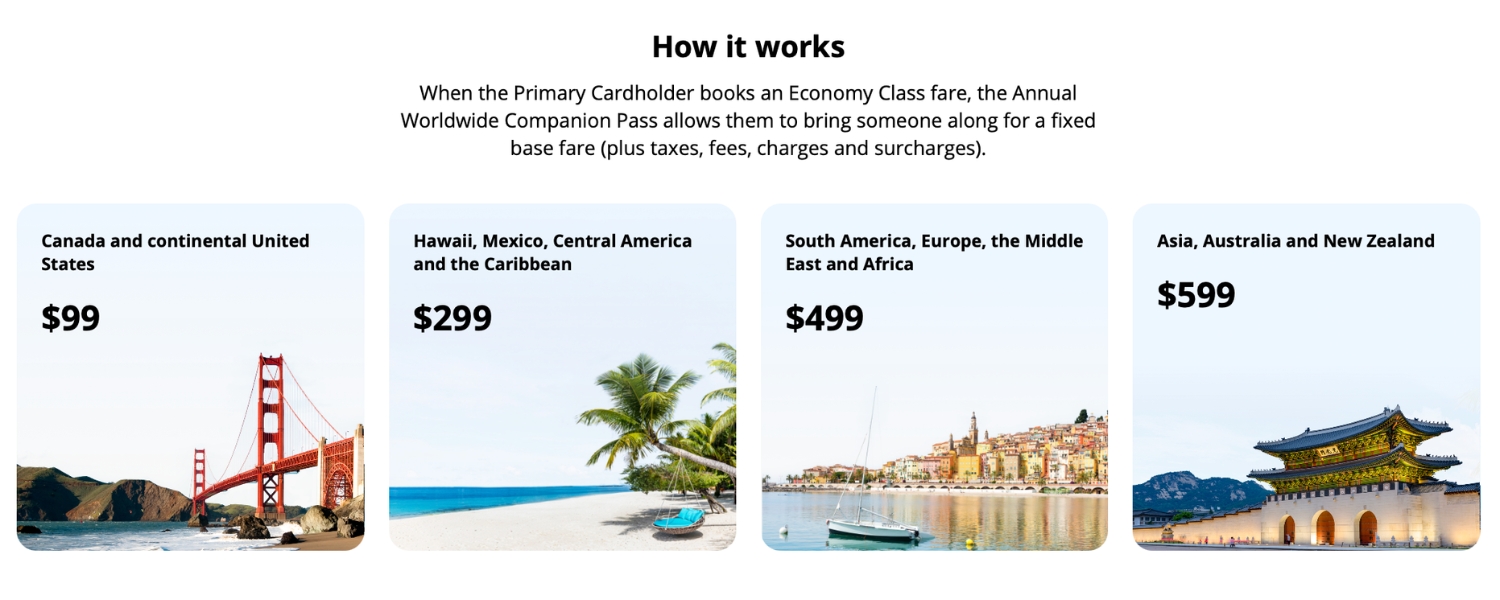
This is where the value math lives. The fixed base fare your companion pays depends on where you're flying:
| Destination region | Companion base fare |
|---|---|
| Canada & continental US (excluding Hawaii) | $99 |
| Hawaii, Mexico, Central America & the Caribbean | $299 |
| South America, Europe, the Middle East & Africa | $499 |
| Asia, Australia & New Zealand | $599 |
All travel has to originate or terminate in Canada or the US. There are no blackout dates, and the pass even works on fares that are already on sale.
How the Value Math Actually Works

The pass replaces your companion's base fare with the fixed tier price. So the question is always the same: is the regular base fare higher or lower than the tier?
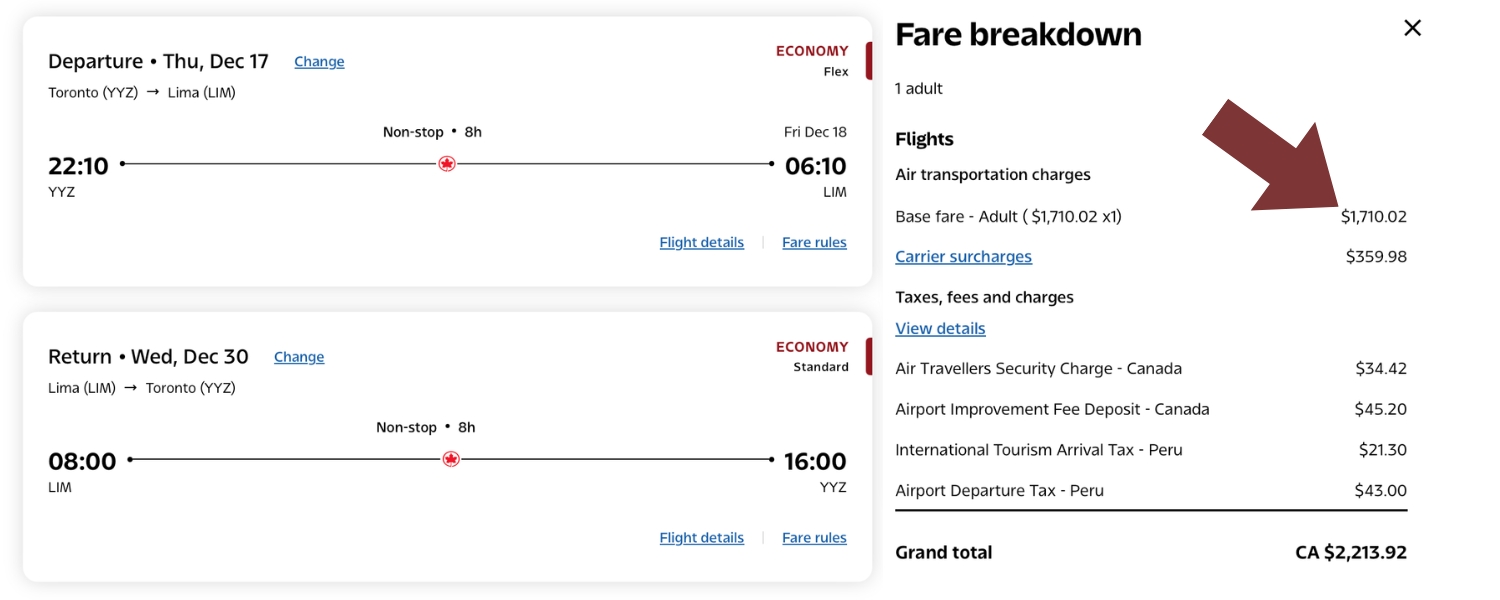
Say you're flying from Toronto to Lima round-trip over the Christmas holidays. Demand is high enough that on some flights the cheaper economy fares are already gone: on this itinerary the outbound has sold up to a Flex fare while the return is still a Standard fare, which pushes the base fare up to around $1,710 before taxes and surcharges.
Your companion's tier for South America is $499. Apply the pass and you've knocked $1,211 off your companion's base fare, on top of whatever taxes and surcharges still apply to both of you. That's a strong use of the pass, and exactly the kind of long-haul, peak-season booking where the pass earns its keep.
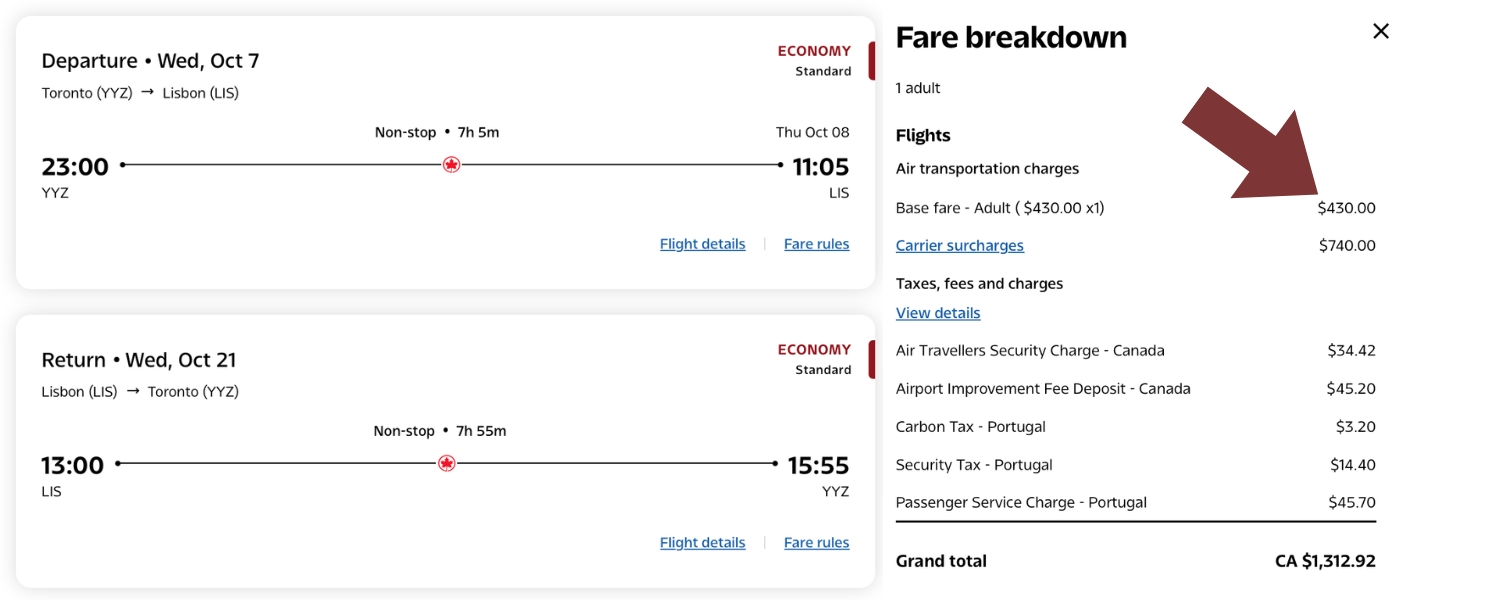
Now flip it. Say you're booking Toronto to Lisbon round-trip in the off-season, and fares are soft. The economy base fare here is just $430. Your companion's tier for Europe is $499.
Apply the pass and you'd actually pay $69 more on the base fare than if you simply booked a second economy ticket the normal way. Even though this is a long-haul European route, the pass works against you here, because the base fare has dropped below the tier. You'd be better off saving the pass for a busier date or a pricier route, and booking the second seat outright.
The pattern is clear: the higher the base fare relative to your tier, the more the pass is worth. That's why long-haul, last-minute, and peak-season bookings are where it pays off, and why a cheap fare can be a poor use of the pass even on a long-haul route.
The Fine Print That Trips People Up

Source: Air Canada.
This is usually where the "it's hard to redeem" reputation comes from. None of it is complicated, but it's worth knowing going in:
- Economy only. The pass is exclusive to Economy Class fares. It can't be applied to Premium Economy or Business Class bookings directly (though there's a workaround below).
- Your companion still pays taxes, fees, and surcharges. This is the big one for anyone frustrated by carrier surcharges. The fixed tier price covers the base fare only. All the taxes, fees, charges, and surcharges still stack on top for your companion, just as they would on any ticket. The pass does not make those disappear.
- Same itinerary, booked together. Your companion has to be on the same flights as you, booked at the same time. You can't add them later.
- Not combinable. The pass can't be used with Aeroplan flight rewards, Flight Pass, group travel bookings, Air Canada Vacations packages, or any other discount or promo code.
- One-way is allowed, but wasteful. You can book a one-way with the pass, but it gets fully consumed and the return portion is forfeited. Round-trip almost always extracts more value.
- It can't be transferred. The pass is tied to you, has no cash value, and can't be handed off to someone else.
- Book before it expires. Your booking has to be made before the pass's expiry date. The good news is your travel can fall after the expiry date, as long as the flights are available when you book.
You can check whether your pass is sitting in your account through the Air Canada app (under the Aeroplan tab, scroll to "Available benefits") or on the website (sign in, go to "My Aeroplan," select "Benefits").
The Trick Most People Miss: eUpgrades

Source: Air Canada.
Here's the part that quietly makes the pass more interesting than it looks. The pass itself is economy-only, but that doesn't mean you're locked in economy for the whole flight.
AC Bid Upgrade and Last Minute Upgrades are both in play depending on the fare class you bought, and you can also use eUpgrade credits to move up. If you book a Latitude fare and there's space in Premium Economy or Business, you have a real shot at clearing an upgrade, though it's never guaranteed and depends on availability closer to departure. So in the right scenario, you can use the companion pass to lock in a cheap economy base fare, then use eUpgrades to lift one or both of you into a premium cabin. That stretches the pass well beyond its economy ceiling.
Getting the Most Value Out of Your Pass

Pulling it all together, here's how to make the pass actually pay:
- Aim high. Save it for the higher tiers. A $499 or $599 tier applied to an expensive long-haul base fare delivers far more than the $99 tier applied to an already-cheap fare.
- Book when fares are inflated. Last-minute and peak-season bookings mean higher base fares, which means more savings against your fixed tier.
- Watch the surcharges. Before you commit, confirm the base fare you're replacing is actually higher than your tier. If it isn't, skip the pass.
- Pair it with eUpgrades. A Latitude fare plus eUpgrade credits can turn an economy companion booking into a premium-cabin trip.
- Use it before it expires. It's only valid for 12 months, so don't let it lapse.
- Don't close or downgrade the card. The pass is automatically cancelled if you close the card or switch to a different product, regardless of the reason.
So Should You Renew the Card?

Back to our group member's actual question. The companion pass is one benefit among several that come with a premium Aeroplan card, and it shouldn't be the only thing you weigh against the annual fee.
If you travel long-haul, book during busy periods, or take at least one bigger trip a year where the pass clears real value, it can comfortably justify a chunk of the fee on its own. If your travel is mostly cheap fares booked well in advance, the pass will be harder to cash in, and you should look at the card's other perks, points earning, and Air Canada benefits to decide whether renewal makes sense.
The pass is a tool. In the right hands, on the right trip, it's a strong one. On the wrong trip, it's not worth bending your plans around.
Have a Question of Your Own?

This whole post started with one member's question in our Facebook group. If you've got one of your own, or you've used a companion pass and want to share how it went, come join the Canadian Jetsetter Facebook group. It's a friendly crowd of Canadian travellers swapping deals, points strategy, and honest advice every day.
Happy travels!