
June 30, 2026
General TravelThe Truth About Airline Flight Sales and Dynamic Pricing

I recently read a CBC story about a Montreal couple who did everything right and still came out behind. They had booked a return Air Canada flight from Montreal to Chicago, then spotted a 25% off sale just 15 hours later. Still inside the 24-hour cancellation window, they cancelled and rebooked to grab the discount. The result? Their new tickets, with the bigger discount applied, cost $5.71 more than the originals.
It got me thinking about how confusing airline pricing really is for most Canadians. How sales actually work, why a "discount" doesn't always discount what you think it does, and why prices seem to jump around so much and so fast.
The couple's situation sounds like a glitch. It isn't. It's just how airline pricing works, and once you understand two things, you'll never read a flight sale the same way again. The first is that the discount almost always applies to the base fare only, not the whole ticket. The second is that the base fare itself is constantly moving. Let's break both down with real numbers.
A Plane Ticket Is Not One Price
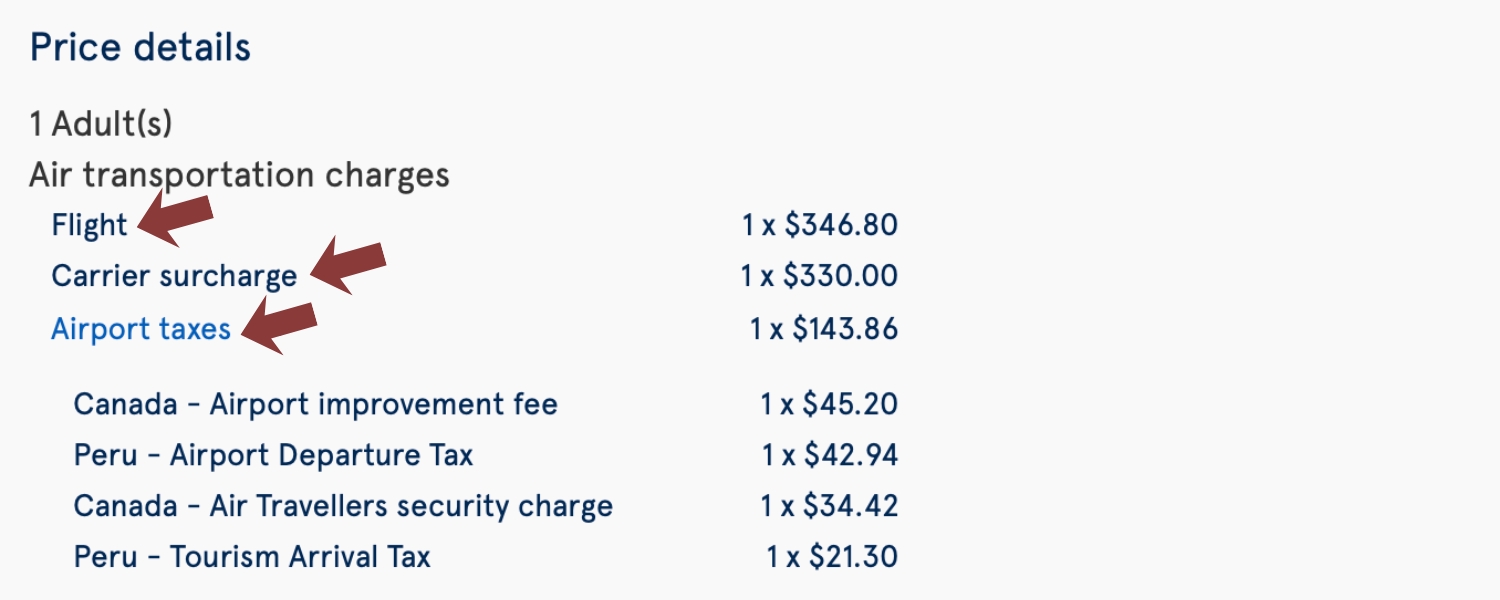
When you see a total fare, you're actually looking at three very different things stacked together:
The base fare is the airline's own charge for the seat. This is the part that moves with demand, and crucially, it's almost always the only part a sale touches.
Carrier surcharges are extra fees the airline adds on top, often labelled as fuel or operational surcharges. They can be substantial, sometimes larger than the base fare itself, and a "% off base fare" promo does nothing to them.
Taxes and fees are government and airport charges. Things like the Air Travellers Security Charge, airport improvement fees, and various foreign departure or tourism taxes. A sale never touches these either.
So when an ad says "15% off," it almost always means 15% off that first bucket only. Depending on the route, that bucket might be most of your ticket, or it might be a small slice of it. That single fact is the difference between a great deal and a forgettable one.
A Real Example: The Live Air Transat Sale
Source: Air Transat
Right now, Air Transat is running a 15% off base fare promotion (code BIQ36CA15, valid on Air Transat-operated flights, excluding Eco Budget fares). It's a perfectly legitimate sale, and pricing out a real route is a great way to see exactly what that 15% applies to.
Here's a Montreal to Rome booking with the promo applied:
- Base fare: $345.95
- Carrier surcharge: $825.00
- Airport taxes: $144.77
- Total: $1,315.72
- Discount applied: −$61.05
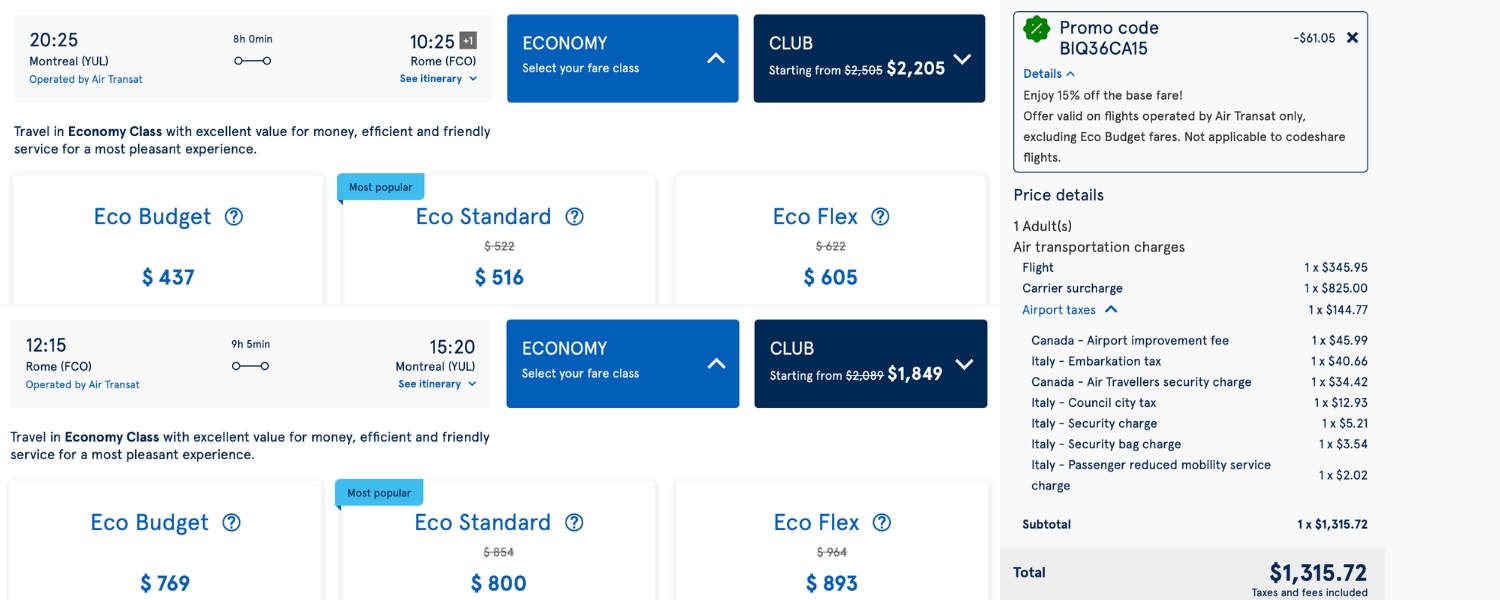
The discount did its job. It came off the base fare, just like the promo says. But look at where the money actually sits on this ticket. The base fare is only $345.95. The carrier surcharge is more than double that at $825.00, and on top of it there's another $144.77 in taxes and fees. The sale touches the smallest piece of the ticket and leaves the two biggest pieces completely alone.
That's why the math feels underwhelming once it's all added up. A $61.05 discount on a $1,315.72 total works out to an effective 4.6% off what you actually pay, even though the ad said 15%. The headline number describes a slice of the fare you might not even realize is the small part. The advertised percentage tells you nothing about your real savings until you see how the ticket is built.
The Fine Print That Shrinks It Further

It's also worth reading the conditions, because they often quietly cost you. This particular sale excludes Eco Budget, the cheapest fare class. On the Montreal to Rome route, Eco Budget runs $437, but to use the code at all you'd have to move up to Eco Standard at $516. So qualifying for the "discount" means starting from a fare that's $79 higher. The savings are real, but they're working against a higher starting point than the cheapest seat on the same flight.
It's worth doing the full comparison before you commit. Depending on what you actually need for your trip, the cheaper fare that isn't on sale can still come out ahead. Eco Standard includes a checked bag and lets you make changes for a fee, so if you weren't going to use those anyway, paying up to unlock the discount may cost more than just booking Eco Budget at its regular price. But if you need those extras regardless, the discounted higher fare might be the better value. The only way to know is to price out both against what your trip actually requires.
The other restrictions here are typical of airline promos in general. Sales are often limited to flights the airline operates itself, with codeshare flights excluded, and the cheapest fare classes carved out. None of this makes a sale a bad one. It just means the headline number and your actual outcome can be two different things.
Why the Price Keeps Moving Even During a Sale

Now back to that Montreal couple who paid more. The reason isn't the percentage. It's that the base fare moved underneath them.
Airlines use dynamic pricing, which means fares shift in real time based on demand, timing, and how many seats are left at each price. Behind every route is a set of fare buckets: a limited number of seats at the lowest price, then the next batch at a higher price, and so on. As the cheap buckets sell out, the next available fare becomes the new starting point.
A sale can actually speed this up. When a promotion drives a rush of bookings, the cheapest seats go first, and the base fare that's left for everyone after is higher. In the Air Canada case, the airline explained that the couple's base fare had climbed $26.28 in the 15 hours between their two bookings because demand was strong and the lower-priced seats were gone. The 25% discount was real. It was just being applied to a base fare that had already risen, which is how a bigger discount produced a bigger bill.
What This Actually Means for You

None of this means flight sales are a trick, or that you should ignore them. Plenty of them are worth acting on. It just means you have to read them differently:
Judge the total, not the percentage. Note the all-in price before a sale, then compare it to the all-in price after. The headline percentage is the least useful number on the screen.
Watch the fine print on fare class. If a promo excludes the cheapest fare, factor in the cost of moving up to qualify before you decide it's a deal.
Move quickly on truly good fares. Because buckets sell out, a great price can disappear or quietly tick upward while you deliberate. That urgency is real, even if airlines also benefit from it.
Remember that surcharge-heavy routes get less out of base-fare sales. A lot of European routes carry hefty carrier surcharges, so a percentage off the base fare won't stretch as far as it would on a route where the base fare is most of the cost.
The Bottom Line

Airline sales are real, and plenty of them are worth jumping on. The trick is knowing what you're actually looking at. A percentage off only ever applies to the base fare, never the carrier surcharges or taxes, so the headline number rarely matches what lands on your final bill. And because the base fare moves with demand, the price you see today might not be the price you see an hour from now.
So stay vigilant and judge the total, not the percentage. If you book an itinerary and a sale pops up within your 24-hour cancellation window, don't cancel and rebook on faith. Pull up the exact same flights, apply the discount, and check the new all-in total against what you already paid. There's a real chance the discounted fare comes out higher, because your original booking may have caught a lower fare bucket that's since sold out.
The sale is only a win if that final number is actually lower, and that's something you can always confirm for yourself before you give up the booking you've got.